From a religious point of view we see absolutes and abstractions, without exceptions.
From the point of view of politics we see accommodations and compromises.
From the point of view of ethics we see gradations, reservations, and qualifications.
From the point of view of law we see case by case adjustments, idealisitic principles and applications of them to well defined facts and a uncertainty with regard to the application of those principles to new facts.
Should you be able to conceive a child naturally, through surrogacy, or through in vitro fertilization if that baby is going to be used for a specific purpose later (e.g. cord blood for bone marrow transplant for another child)?
What if the embryo is going to be destroyed before implantation (or after transplantation) to be used for the specific purpose?
Should you be able to have a child if you use drugs or drink during pregnancy?
Should you be able to choose not to have a baby? Why, what reasons?
Should you be able to choose not to have a baby for any reason (i.e. gender, retardation, money)?
How should you be able to choose not to have a baby? By contraception? By morning after pill? By termination of the pregnancy?
Should you be able to choose not to have a baby by the selective reduction of implanted fertilized eggs?
Should you be able to refuse to have all of the fertilized embryos implanted?
Should you then be able to choose not to have a baby who is genetically related to you, by directing the clinic to destroy those fertilized embryos?
Should you be able to refuse to have a cesarean to save the life of the baby?
Should society be able to say "you must have this baby" or "you should not have this baby"?
Should society be able to say that you cannot have a posthumously implanted embryo?
Wednesday, October 3, 2007

Monday, October 1, 2007
Who Has the Oil?
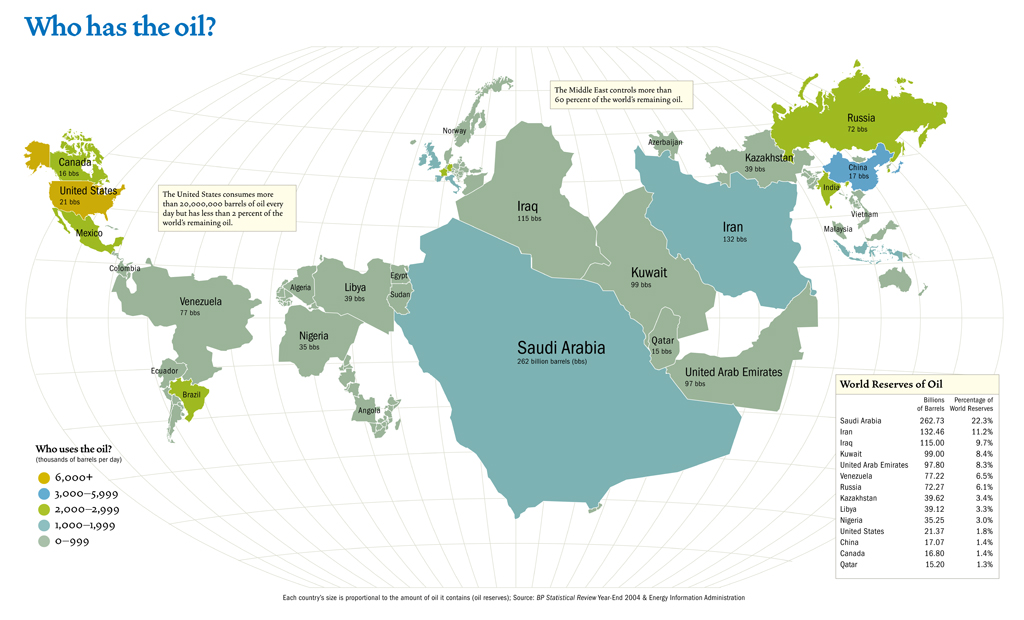
The map above shows what the world would look like if each country’s size was proportional to their proven oil reserves. Definitely makes you think about how increasing oil prices and the lack of any meaningful reduction in demand for oil could (is?) shifting the balance of power in the world.
Saturday, September 15, 2007
Maps of Globalization
Princeton's searchable collection of historical maps and present-day analysis, including Artists' Travels in the Renaissance, an 1891 ethnographic chart, Telegraph Lines in 1869, Global Terrorism c. 1983, Oil reserves vs. consumption, a visualization of world development since 1960.


Wednesday, September 12, 2007
Globalization as Westernization
My position:
Previously the world was dominated by a geographic, state based system. Globalization is driving the world to a market based, corporate based system. Early in the formation of the state based system there was little incentive for concern about the rights and lives of individuals in the pursuit of political and geographic power. The same is true now in the global economy; there is little concern about the rights and lives of individuals in the pursuit of economic success. Perhaps the corporation in some form may become the dominant form of organization in the modern world.
Previously the world was dominated by a geographic, state based system. Globalization is driving the world to a market based, corporate based system. Early in the formation of the state based system there was little incentive for concern about the rights and lives of individuals in the pursuit of political and geographic power. The same is true now in the global economy; there is little concern about the rights and lives of individuals in the pursuit of economic success. Perhaps the corporation in some form may become the dominant form of organization in the modern world.
Friday, September 7, 2007
A user in Second Life has created a virtual ecosystem within the game!
While taking a break from the UK game industry to raise her child, a programmer created a self-contained ecology on a Second Life island, with numerous species and natural phenomenon that must work together to keep the system function: clouds rain on the land, nourishing the plants (which also respond to sunlight), bees spread pollen to help the plants reproduce, birds eat seeds to keep the plants from growing out of control, and so on.

While taking a break from the UK game industry to raise her child, a programmer created a self-contained ecology on a Second Life island, with numerous species and natural phenomenon that must work together to keep the system function: clouds rain on the land, nourishing the plants (which also respond to sunlight), bees spread pollen to help the plants reproduce, birds eat seeds to keep the plants from growing out of control, and so on.

Thursday, September 6, 2007
Virtual Tour Operator
Synthtravels is a tour operator that arranges for guided visits to virtual worlds like World of Warcraft and Second Life, providing "native guides" for people who want to get the lay of the land.  Synthravels is the first organization to offer a complete guide service to all the people who want to make a tour in virtual worlds without knowing these new realities, even if they have never put their feet in these strange, synthetic grounds. The tours and the destinations are chosen by the staff of Synthravels, composed by programmers, architects, experienced video gamers.
Synthravels is the first organization to offer a complete guide service to all the people who want to make a tour in virtual worlds without knowing these new realities, even if they have never put their feet in these strange, synthetic grounds. The tours and the destinations are chosen by the staff of Synthravels, composed by programmers, architects, experienced video gamers.
Wednesday, September 5, 2007
The West and the Rest
Culture is our biggest most general term for everything there is.
It is an artifact, a framework which varies from culture to culture.
What constitutes culture?
The way people reason and even perceive can vary across cultures. The whole way of organizing reality can vary from culture to culture.
The perceived fundamental rights of people vary across cultures.
What is normal varies from culture to culture.
Causes and origins are seen as different from culture to culture. Are they under human control, human influence, divine control, etc.
If society were structured based on the mother-child relationship, rather than the concept of the independent male, what would the resulting society look like? Would men feel inherently discriminated against because they were less essential to the mother child relationship than women, just as women feel inherently discriminated against in a male oriented society because of their lack of choice in the mother-child relationship?
Western assumptions: the male is the norm, and nature is there to be exploited.

It is an artifact, a framework which varies from culture to culture.
What constitutes culture?
The way people reason and even perceive can vary across cultures. The whole way of organizing reality can vary from culture to culture.
The perceived fundamental rights of people vary across cultures.
What is normal varies from culture to culture.
Causes and origins are seen as different from culture to culture. Are they under human control, human influence, divine control, etc.
If society were structured based on the mother-child relationship, rather than the concept of the independent male, what would the resulting society look like? Would men feel inherently discriminated against because they were less essential to the mother child relationship than women, just as women feel inherently discriminated against in a male oriented society because of their lack of choice in the mother-child relationship?
Western assumptions: the male is the norm, and nature is there to be exploited.

Subscribe to:
Posts (Atom)


